
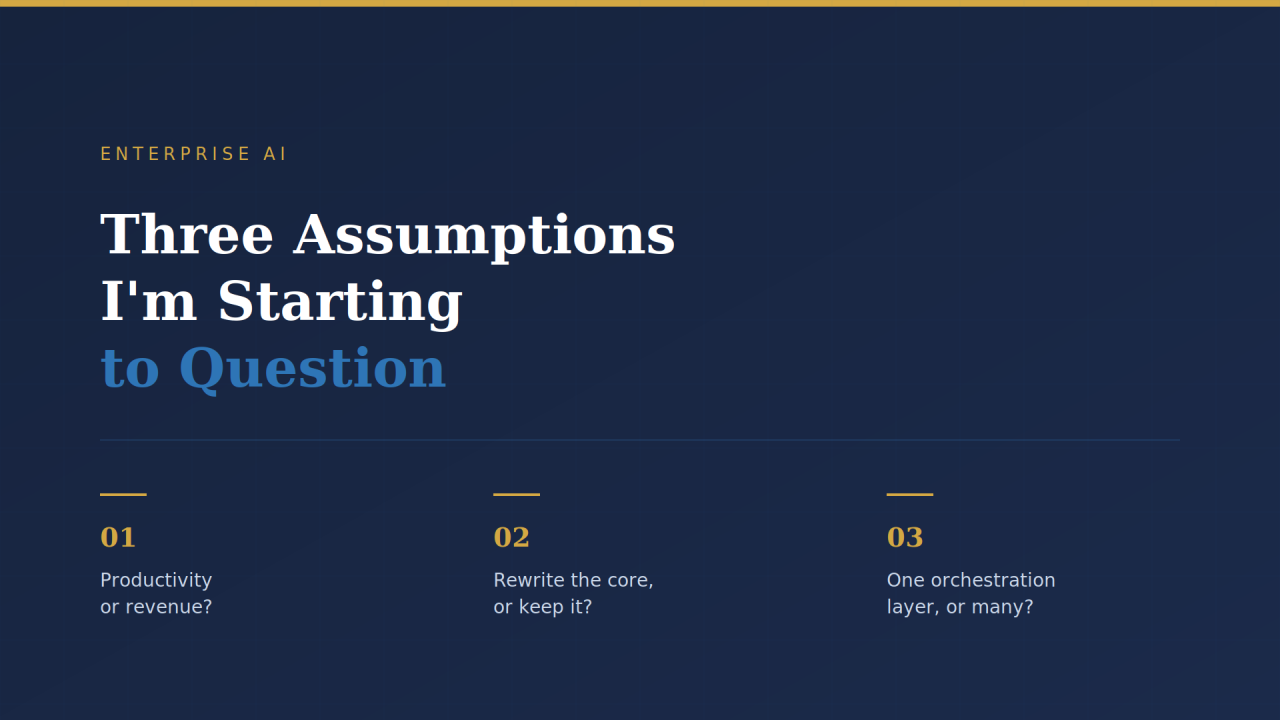
A recent conversation with a senior leader at one of the largest companies in the world challenged three assumptions that show up in most enterprise AI discussions. I have been testing them with other clients since.
1. That AI’s value comes from productivity
This company is deliberately putting AI into use cases that drive revenue. They are not that excited about individual productivity. That will happen naturally, but they aren’t going after it on purpose. Their focus is effectiveness over efficiency, which they describe as above the line (ATL) rather than below the line (BTL).
Most AI business cases I have seen were built on hours saved and headcount avoided, because that is what CFOs are comfortable funding. The problem is that productivity gains rarely reach the P&L unless someone takes the cost out. And when every company in an industry is using the same models, the lift doesn’t last as an advantage.
Revenue use cases in pricing, yield, conversion or retention take longer to build and are harder to measure. When they work, the benefit keeps growing, and it is hard to copy because it depends on the company’s own data and processes. So they are making a deliberate trade toward fewer use cases that matter more.
2. That AI will lead enterprises to rewrite their core systems
A popular argument is that AI will make software so cheap to build that enterprises will rebuild what they currently buy. They don’t think that applies to systems of record like SAP or Oracle, or to enterprise SaaS like Salesforce or ServiceNow. Some rewriting will happen, but mostly in smaller niche apps over the short to medium term. I hear the same view from almost every large enterprise I talk to.
When you buy an SOR, most of what you pay for is years of process logic, edge cases, regulatory requirements and integrations. AI can speed up writing code, but it won’t give you back twenty years of decisions nobody wrote down. The stakes are higher too, since an error in the general ledger can mean a restatement. And the major vendors are building AI into their own products, so a rewrite would be competing against their version with all their customer data behind it.
Where rewriting does make sense is the long tail of custom and departmental apps that were built once and hardly touched since, along with apps that were never built because the economics didn’t work.
3. That one platform will own orchestration
They don’t want to be locked into a single vendor, so they are planning for several orchestration platforms. The ServiceNow ecosystem, the SAP ecosystem and domain-specific workflow platforms may each have their own orchestration layer, each working best where its data and permissions live. Over time these could all be managed through something like Microsoft Foundry, with MCP or A2A protocols handling the use cases that cut across layers.
Part of the reasoning is commercial. Whichever platform decides which agents run and on what data will have a lot of leverage at renewal time, and most CIOs have been through enough SOR renewals to avoid handing any one vendor that position.
The hard part will be connecting the layers. The most valuable use cases span several of them, and the protocols are still early. If MCP and A2A don’t mature fast enough, companies may end up building integration middleware again.
What this means
Enterprises will need a way to fund AI work that pays off in revenue and takes longer to prove, and that work has to be owned by the business leader responsible for the P&L rather than a central AI team. On modernization, most companies will keep their SORs and build agents on top of them, with replacement happening first in the smaller apps.